If you are new to the longevity supplement space, the alphabet soup of related molecules can be genuinely disorienting. NAD+, NMN, NR, NADH — they appear on supplement bottles, in podcast discussions, and across health articles, often used interchangeably when they are not the same thing at all. Some are coenzymes your cells produce and use. Others are precursor molecules your body converts into something else. One is a supplement with questionable absorption. Understanding the distinctions is not just academic: it directly affects which supplements are worth considering, what the research actually shows, and what you should be skeptical of. This article lays it out clearly in one place.
The Quick-Reference Comparison
Before going deeper, here is the landscape at a glance. Each molecule occupies a distinct position in the NAD+ story — as a finished coenzyme, a biosynthetic intermediate, or a supplement that your body converts into something usable.
| Molecule | What It Is | Role in the Body | Can You Supplement It? | Does It Work as a Supplement? |
|---|---|---|---|---|
| NAD+ | Coenzyme (oxidized form) | Fuels sirtuins, PARP enzymes; accepts electrons in energy metabolism | Yes, but poorly absorbed orally | No meaningful evidence for oral effectiveness; IV administration studied but impractical |
| NADH | Coenzyme (reduced form) | Carries electrons to mitochondria to generate ATP; converts back to NAD+ | Yes, sold as a supplement | Limited; some small studies suggest modest energy benefits but evidence is weak |
| NMN | NAD+ precursor (biosynthetic intermediate) | Converted to NAD+ inside cells; sits one step upstream of NAD+ in the salvage pathway | Yes, widely available | Yes — human trials confirm it raises NAD+ levels; FDA confirmed legal status in 2025 |
| NR | NAD+ precursor (biosynthetic intermediate) | Converted to NMN, then to NAD+; enters salvage pathway two steps upstream of NAD+ | Yes, widely available | Yes — human trials confirm it raises NAD+ levels; longer track record than NMN in human research |
NAD+: The Molecule Everything Else Is Working Toward
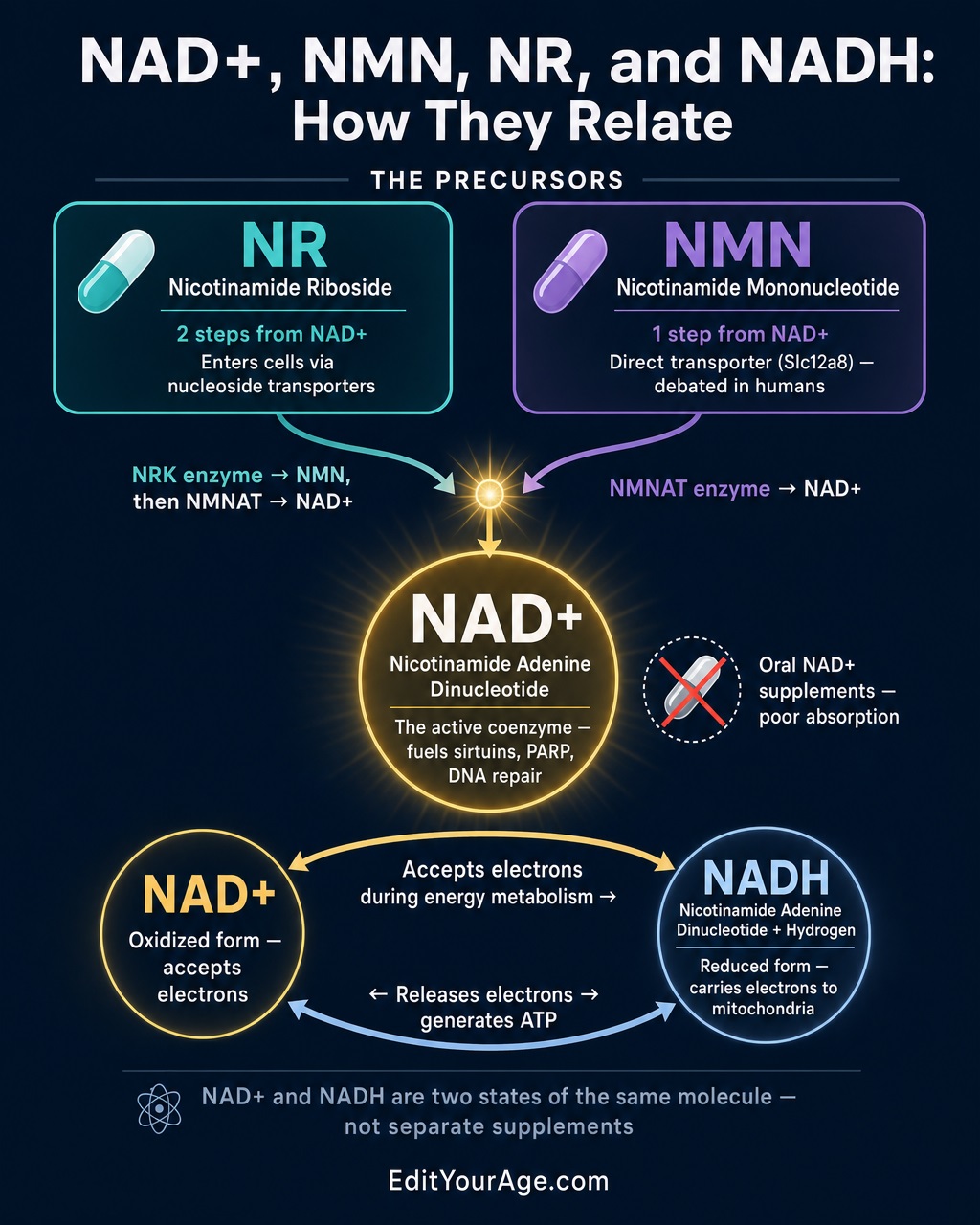
NAD+ (nicotinamide adenine dinucleotide) is the finished coenzyme — the molecule that actually performs the biological functions this entire field of research is concerned with. It fuels the sirtuin proteins that regulate DNA repair and stress response. It is consumed by PARP enzymes during DNA damage repair. It accepts electrons during the breakdown of glucose and fatty acids in cellular respiration. Without adequate NAD+, none of these processes can run at full capacity.
The reason NAD+ itself is a poor supplement candidate comes down to chemistry and biology. NAD+ is a large, electrically charged molecule. Taken orally, it is broken down in the digestive tract before meaningful amounts can be absorbed. Even if it reaches the bloodstream intact, it cannot cross cell membranes efficiently in its complete form. Research has not demonstrated that oral NAD+ supplements meaningfully raise intracellular NAD+ levels in humans. Some clinics offer NAD+ by intravenous infusion, which does deliver the molecule directly into the bloodstream, but the research on IV NAD+ is limited and the cost and inconvenience make it impractical as a regular intervention for most people. Our dedicated article on why you cannot take NAD+ directly covers this in more depth.
The practical conclusion is that if your goal is to raise intracellular NAD+ levels, you need to work with precursors — smaller molecules that your cells can absorb and convert — rather than NAD+ itself.
NADH: The Other Form of the Same Molecule
NADH is not a separate molecule from NAD+ — it is the same molecule in a different chemical state. When NAD+ accepts electrons during energy metabolism, it becomes NADH (the “H” refers to the hydrogen ion it picks up along with those electrons). NADH then delivers those electrons to the mitochondrial electron transport chain, which uses them to generate ATP. In the process, NADH releases the electrons and converts back to NAD+. This cycle runs continuously in every metabolizing cell.
NADH supplements have been sold for decades, primarily marketed for energy and cognitive function. The research base is thin. A small number of studies — mostly older and involving very small participant numbers — have shown modest improvements in fatigue or alertness with oral NADH supplementation. The mechanism is unclear, since NADH faces the same absorption challenges as NAD+. Some researchers speculate that NADH supplements may work partly by conversion to NAD+ in the gut, or through mechanisms not yet fully characterized. What is clear is that NADH supplements have far less human clinical evidence behind them than NMN or NR, and the evidence that does exist is not compelling by current standards.
If you see NADH supplements prominently marketed as a NAD+ booster, appropriate skepticism is warranted. It is not in the same evidence category as NMN or NR.
NMN: One Step From NAD+, With Growing Human Evidence
NMN (nicotinamide mononucleotide) is the biosynthetic intermediate that sits directly upstream of NAD+ in the salvage pathway. When the body’s own NAMPT enzyme converts nicotinamide into NMN, that NMN is immediately converted to NAD+ by NMNAT enzymes. Supplementing with NMN effectively delivers that intermediate directly, bypassing the NAMPT bottleneck that limits NAD+ production in aging cells.
NMN is one step closer to NAD+ than NR in the biosynthetic pathway — it requires only the NMNAT conversion step to become NAD+, whereas NR requires two steps (NR to NMN via NRK, then NMN to NAD+ via NMNAT). Whether this biochemical proximity translates into a meaningful practical advantage in humans is still debated, and that debate is covered in our dedicated NMN vs. NR comparison.
NMN’s Regulatory History Is Worth Knowing
NMN had an unusual regulatory journey in the United States that is relevant for anyone buying supplements. In 2022, the FDA withdrew its recognition of NMN as a dietary supplement ingredient, citing its prior investigation as a drug under an Investigational New Drug authorization — a technicality that created years of legal uncertainty. Following a lawsuit by the Natural Products Association and sustained industry pressure, the FDA reversed its position in September 2025 and confirmed that NMN is not excluded from the dietary supplement definition. NMN is now legally sold as a dietary supplement in the United States. The full regulatory history is covered in our article on why the FDA restricted NMN and why it is legal again.
What Human Trials Have Shown
Multiple human clinical trials have demonstrated that NMN supplementation raises NAD+ levels in blood, and some have shown associated benefits including improved insulin sensitivity in prediabetic women, improvements in physical performance metrics, and increased muscle NAD+ levels. A 2023 randomized trial found that 300 mg per day of NMN raised blood NAD+ levels by approximately 38% after 30 days in adults over 45. A 2026 head-to-head trial comparing 1,000 mg per day of NMN against the same dose of NR found that both compounds approximately doubled circulating NAD+ levels after 14 days, with no statistically significant difference between them. The complete picture of NMN human research is covered in our article on NMN clinical trial results.
NR: More Steps From NAD+, but a Longer Research Track Record
NR (nicotinamide riboside) is structurally similar to NMN but lacks a phosphate group, making it slightly smaller. It enters the salvage pathway two steps upstream of NAD+: NRK enzymes add a phosphate group to convert NR into NMN, and NMNAT then converts NMN into NAD+. NR can also be absorbed and converted to nicotinamide in the bloodstream before entering cells, with that nicotinamide then recycled through the normal salvage pathway.
NR’s key practical advantage over NMN is its research history. NR has been studied in human clinical trials since 2016, giving it nearly a decade of accumulated human data. Multiple well-designed trials have confirmed that NR raises blood NAD+ levels and has been well tolerated in doses up to at least 2,000 mg per day. NR also tends to be less expensive per milligram than NMN, which is a meaningful consideration for people supplementing long-term. The complete NR evidence base is covered in our article on NR clinical trial results.
A Key Structural Difference That Affects Cellular Entry
Because NR lacks the phosphate group that NMN carries, it does not face the same cell membrane permeability challenges. NR enters cells through equilibrative nucleoside transporters — a family of transport proteins present in most cell types — without requiring prior conversion. Once inside the cell, NRK converts it to NMN, which NMNAT then converts to NAD+. NMN’s cellular entry is more complex and contested, as discussed in our NAD+ pathway explained article. Whether NR’s more straightforward cellular entry translates to superior NAD+-raising in practice is not settled by current human data — the 2026 head-to-head trial found no significant difference in NAD+ elevation between the two at comparable doses.
How These Molecules Relate to Each Other: The Hierarchy
Placing these four molecules in their correct relationships makes the whole picture clearer. NAD+ is the destination — the active coenzyme that performs biological functions. NADH is the reduced partner of NAD+, formed during energy metabolism and cycling back to NAD+ continuously. NMN and NR are upstream precursors that the body converts into NAD+ through the salvage pathway, with NR two steps away and NMN one step away.
When people talk about “boosting NAD+” through supplementation, they are almost always referring to NMN or NR — not NAD+ directly, and not NADH. The supplement market contains products labeled as all four of these molecules, and the labeling does not always make the distinctions clear. A product sold as “NAD+” is chemically different from a product sold as “NMN” or “NR,” and the evidence for each is very different.
Which One Should You Actually Consider Taking?
For most people whose goal is to support NAD+ levels as part of a longevity-oriented supplement approach, the practical choice is between NMN and NR. Both have genuine human clinical evidence. Both are widely available. The existing head-to-head data does not clearly favor one over the other in terms of NAD+ elevation, though longer and larger trials may eventually show tissue-specific differences. NR currently has the longer safety track record and is generally less expensive. NMN is one step closer to NAD+ in the pathway, is now on stable regulatory ground in the United States, and has a growing body of clinical research.
Oral NAD+ supplements and NADH supplements are not backed by comparable evidence and are generally not the place to start. If you encounter a supplement product prominently marketing oral NAD+ as equivalent to NMN or NR, that is a claim the evidence does not support.
For specific guidance on choosing an NMN product, see our NMN buying guide. For NR, see our NR buying guide. If you are ready to think about combining these with other longevity supplements, our beginner’s NAD+ stack guide is the right next step.
Frequently Asked Questions About NAD+, NMN, NR, and NADH
Is NMN the Same Thing as NAD+?
No. NMN (nicotinamide mononucleotide) is a precursor to NAD+ — a smaller molecule that your cells convert into NAD+ through the salvage pathway. NAD+ is the finished coenzyme that performs biological functions including fueling sirtuin proteins and participating in energy metabolism. Taking NMN raises NAD+ levels indirectly, by supplying the body with the intermediate it needs to produce more NAD+. Taking NAD+ directly does not reliably raise intracellular NAD+ levels because NAD+ is poorly absorbed orally.
Why Is NR Cheaper Than NMN if They Do Similar Things?
The price difference comes primarily from manufacturing complexity and market dynamics rather than from evidence of superiority. NMN has a phosphate group that NR lacks, making its synthesis somewhat more complex. NR has also been commercially available for longer, with more established manufacturing infrastructure and greater competition among suppliers. The price gap has narrowed as NMN production has scaled, but NR typically remains less expensive per milligram. For long-term supplementation, cost per dose is a legitimate practical consideration alongside the evidence.
Should You Take Both NMN and NR Together?
There is limited evidence specifically addressing the combination, and it is not a standard recommendation. Since both compounds ultimately converge on the same pathway and produce NAD+ through overlapping mechanisms, stacking them at full doses of each does not clearly offer additive benefits over an appropriately dosed single precursor. Some premium combination products include both at partial doses. Our article on whether you can take NMN and NR together covers what the research does and does not show on this question.
What Is the Difference Between Taking NADH and Taking NMN?
They are quite different in terms of both mechanism and evidence. NADH is the reduced form of the NAD+ coenzyme itself, and faces similar absorption challenges to oral NAD+. The human evidence for NADH supplements is sparse and unconvincing by current standards. NMN is a biosynthetic precursor that cells absorb and convert to NAD+ through established enzymatic pathways. Multiple human clinical trials have confirmed that NMN raises NAD+ levels in blood. If raising NAD+ is the goal, NMN has substantially stronger support than NADH.
Do Any of These Molecules Appear Naturally in Food?
Yes, in small amounts. NMN is found in foods including edamame, broccoli, avocado, tomatoes, and beef, though at levels far below what clinical trials have used — typically milligrams per 100 grams of food compared to the 250–500 mg supplement doses studied in humans. NR is present in small amounts in milk and some other foods. NAD+ itself is found in some foods but, as with supplements, it is degraded during digestion. Diet can contribute to the precursor pool but is not a substitute for supplementation when the goal is to meaningfully offset age-related NAD+ decline.