

If you follow longevity research even casually, you will encounter three names repeatedly: sirtuins, AMPK, and mTOR. They appear in discussions of caloric restriction, intermittent fasting, supplements like resveratrol and berberine, and drugs like rapamycin and metformin. They are often described as longevity pathways, or the molecular switches that determine how quickly cells age. Understanding what they actually are — and how NAD+ connects to all three — fills in a critical piece of the picture that supplement labels and podcast summaries rarely explain clearly.
Why These Three Pathways Matter: The Cellular Survival Logic
To understand sirtuins, AMPK, and mTOR, it helps to start with the problem they evolved to solve. Your cells face a fundamental trade-off between two competing modes of operation: growth and reproduction on one hand, and maintenance and repair on the other. When energy and nutrients are abundant, the most evolutionarily advantageous strategy is to grow, divide, and reproduce. When resources are scarce, the better strategy is to slow growth, conserve energy, repair existing damage, and wait for better conditions. These three pathways are the primary molecular machinery your cells use to detect which mode is appropriate and respond accordingly.
The connection to aging is direct: chronic over-activation of growth mode — which is essentially the condition of the average well-fed modern human who never fasts and exercises rarely — appears to accelerate the cellular damage accumulation and loss of maintenance capacity that characterizes biological aging. The interventions most reliably associated with extended lifespan across multiple species — caloric restriction, exercise, intermittent fasting — work partly by pushing these pathways toward maintenance mode. NAD+ sits at the center of this regulation, serving as both a sensor of cellular energy status and a direct activator of one of the three pathways.
Sirtuins: The NAD+-Dependent Longevity Proteins
Sirtuins are a family of seven proteins — SIRT1 through SIRT7 — that function as master regulators of cellular stress response, DNA repair, inflammation, metabolism, and mitochondrial function. They are often described as longevity genes because their activity is consistently associated with improved cellular health and extended lifespan across a remarkable range of organisms, from yeast to mice.
The critical feature of sirtuins for this site is their absolute dependence on NAD+. Sirtuins cannot function without NAD+ — it is the substrate they consume to perform their enzymatic work. When sirtuins deacetylate a target protein (essentially switching a molecular process on or off), they consume one molecule of NAD+ in the process and release nicotinamide as a byproduct. This means sirtuin activity is directly gated by how much NAD+ is available. When NAD+ levels are high, sirtuins are active and performing their maintenance functions. When NAD+ levels fall — as they do with age — sirtuin activity diminishes, and the cellular processes they regulate begin to falter.
What the Seven Sirtuins Actually Do
The seven mammalian sirtuins divide roughly by location and function. SIRT1 and SIRT2 operate primarily in the cell nucleus and cytoplasm, regulating gene expression, DNA repair, inflammation, and metabolic adaptation. SIRT1 in particular is the most studied — it regulates hundreds of target proteins involved in stress resistance, fat metabolism, and the activity of other longevity-associated factors including PGC-1α, which controls mitochondrial biogenesis. SIRT3, SIRT4, and SIRT5 reside in the mitochondria, where they regulate the efficiency of energy production and protect against oxidative damage. SIRT6 and SIRT7 operate in the nucleus with roles in DNA repair, telomere maintenance, and ribosome function.
For practical purposes, SIRT1 and SIRT3 receive the most attention in longevity research. SIRT1’s role in regulating inflammation, insulin sensitivity, and stress response connects it to metabolic aging. SIRT3’s mitochondrial function connects it to the cellular energy decline that accompanies aging. Both require adequate NAD+ to remain active — which is the primary reason that raising NAD+ through precursor supplementation is hypothesized to support longevity-associated outcomes.
Resveratrol, Sirtuins, and the Supplement Connection
Resveratrol, a polyphenol found in red wine and grape skins, became famous partly because early research suggested it could activate SIRT1 directly. David Sinclair’s laboratory at Harvard reported this finding in the early 2000s, and the subsequent media coverage made resveratrol one of the most discussed longevity compounds of the past two decades. The mechanism proposed was that resveratrol acts as a sirtuin-activating compound (STAC), making SIRT1 more sensitive to the NAD+ available. The full picture has proven more complicated — later research showed that resveratrol’s effects depend on the specific substrate being deacetylated, and the bioavailability of standard resveratrol supplements is poor. Nevertheless, the resveratrol-sirtuin-NAD+ combination remains one of the most discussed longevity supplement strategies, covered in our dedicated articles on resveratrol and NMN and resveratrol stacking.
AMPK: The Cellular Energy Sensor That Promotes Longevity
AMPK — adenosine monophosphate-activated protein kinase — is one of the cell’s primary energy sensors. Its job is to monitor the ratio of AMP (a low-energy molecule) to ATP (the cell’s main energy currency). When this ratio rises — signaling that the cell is running low on energy — AMPK activates and initiates a suite of responses designed to restore energy balance and trigger cellular maintenance.
AMPK activation promotes several processes strongly associated with healthy aging: autophagy (the cellular cleanup of damaged proteins and organelles), mitochondrial biogenesis (production of new mitochondria), improved insulin sensitivity, and reduced inflammatory signaling. It also inhibits mTOR, the growth-promoting pathway discussed below — essentially flipping the cellular switch from growth mode toward maintenance mode. Research across multiple organisms consistently links higher AMPK activity to extended lifespan and improved healthspan.
What Activates AMPK Naturally
The most reliably AMPK-activating interventions are also the most consistently longevity-associated lifestyle behaviors: exercise activates AMPK strongly in muscle tissue, particularly through the energy depletion that occurs during sustained physical activity. Caloric restriction and intermittent fasting activate AMPK by reducing cellular ATP availability. Cold exposure activates AMPK in brown adipose tissue. These overlapping mechanisms help explain why exercise and fasting protocols produce such consistent benefits across so many physiological systems — they are converging on a shared pathway.
Several compounds are also studied as AMPK activators. Metformin, the diabetes drug that has attracted significant interest in longevity research, activates AMPK partly by inhibiting complex I of the mitochondrial electron transport chain, which reduces ATP production and raises the AMP/ATP ratio. Berberine, a plant compound studied as a natural alternative to metformin, appears to work through similar mechanisms. Our article on berberine covers this connection in detail.
The AMPK-NAD+ Connection
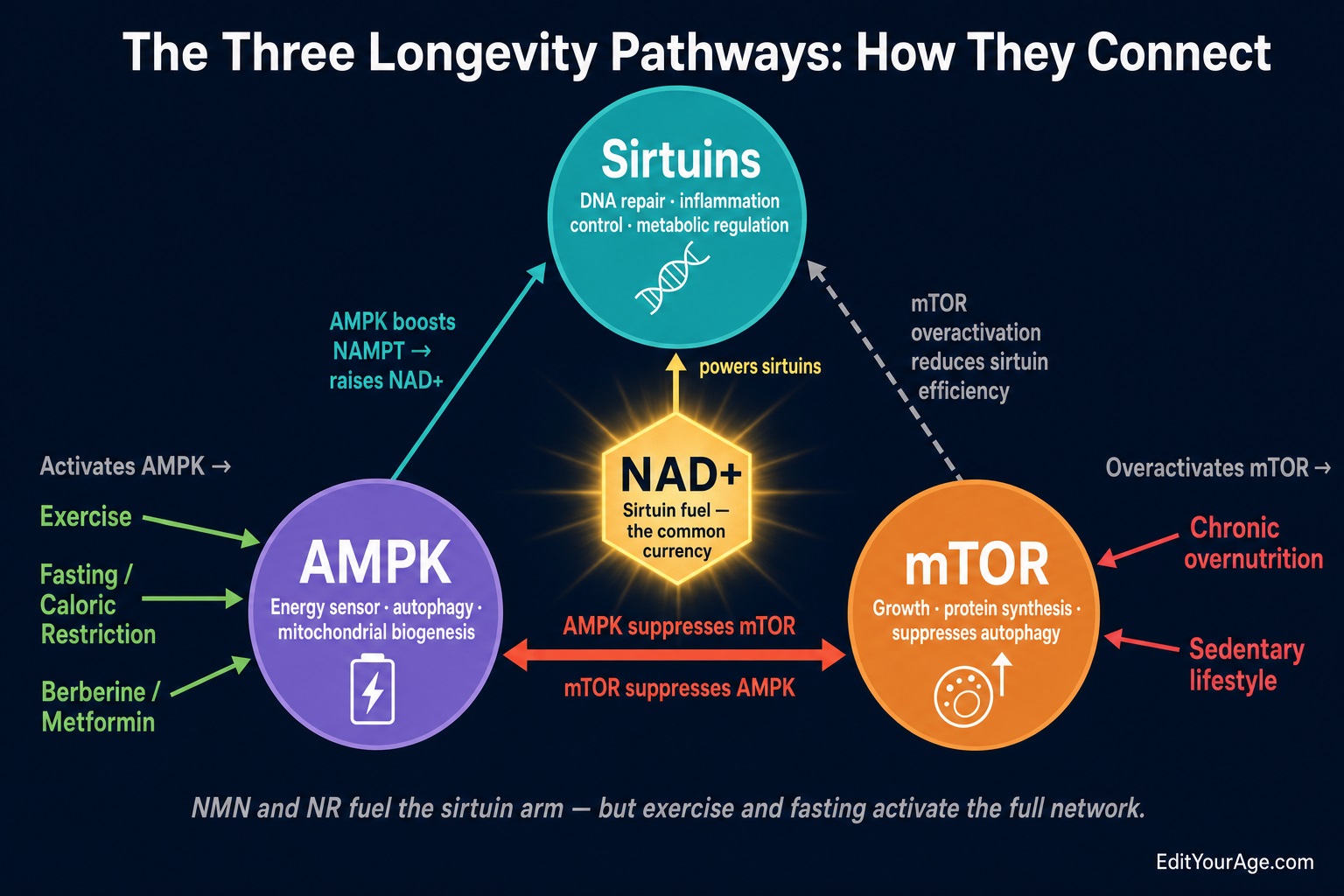
AMPK and the sirtuin pathway are not independent. AMPK activation raises NAD+ levels indirectly by stimulating NAMPT expression — the rate-limiting enzyme in the NAD+ salvage pathway. More NAD+ means more sirtuin activity. This creates a synergistic loop: exercise and fasting activate AMPK, which supports NAD+ production, which fuels sirtuin activity, which further reinforces metabolic maintenance. It also means that the lifestyle factors most strongly associated with healthy aging are operating through coordinated mechanisms rather than isolated ones.
mTOR: The Growth Regulator You Need — in the Right Amounts
mTOR — mechanistic target of rapamycin — is often presented as the villain in longevity discussions, but this framing is incomplete. mTOR is a protein kinase that functions as a master switch for cellular growth. When nutrients, amino acids, and growth factors are abundant, mTOR activates and drives protein synthesis, cell growth, and cell division. These are essential and beneficial processes. The problem is not mTOR activity itself but chronically elevated mTOR activity with insufficient periods of suppression.
When mTOR is chronically active — as it tends to be in overfed, sedentary people who eat frequently throughout the day — it suppresses autophagy, the cellular cleanup process that clears damaged proteins and dysfunctional organelles. Damaged cellular components accumulate. Senescent cells build up. The balance between growth and maintenance tips too far toward growth at the expense of repair. Research in mice has consistently shown that inhibiting mTOR through caloric restriction, fasting, or the drug rapamycin extends lifespan and improves multiple healthspan markers. Rapamycin remains one of the most reliably lifespan-extending interventions identified in mammalian research, though its long-term safety in healthy humans remains under investigation.
mTOR Inhibition: Why Timing and Context Matter
The nuanced picture of mTOR is that you want it active at appropriate times — during and after resistance exercise, for example, when it drives muscle protein synthesis — and suppressed at others, particularly during fasting windows when autophagy should be running. The worst pattern is constant moderate activation with no meaningful suppression periods. This is why protocols that combine exercise with intermittent fasting have attracted interest: the post-exercise mTOR activation drives adaptation and repair, while fasting periods suppress mTOR and allow autophagy to clear the cellular debris that accumulates during activity.
For most people, the practical takeaway from mTOR biology is not to take rapamycin — whose long-term safety profile in healthy individuals is still being established — but to create regular periods of mTOR suppression through fasting and to avoid the chronic over-nutrition pattern that keeps mTOR permanently elevated. Our article on fasting and NAD+ covers the intersection of fasting with both AMPK activation and mTOR suppression.
How All Three Pathways Connect to Each Other and to NAD+
These three pathways are not isolated switches — they form an integrated network that collectively determines the cellular balance between growth and maintenance. AMPK and mTOR are direct antagonists: AMPK activation suppresses mTOR, and mTOR activation suppresses AMPK. Sirtuins are downstream beneficiaries of AMPK activity (through its support of NAD+ production) and co-regulators of many of the same processes that mTOR controls. NAD+ ties the network together by serving as both a readout of cellular energy status and the fuel that powers sirtuin activity.
The practical implication is that these pathways respond to the same inputs — energy availability, exercise, fasting, stress — in coordinated ways. Behaviors and compounds that activate AMPK tend to also suppress mTOR and support sirtuin activity. This coherence is why lifestyle interventions tend to produce broad, systemic benefits rather than narrowly targeted ones. It is also why supplementing NAD+ precursors is not a substitute for the lifestyle behaviors that activate these pathways upstream: NMN or NR can fuel the sirtuin arm of the system, but they do not independently activate AMPK or suppress chronic mTOR overactivation the way exercise and fasting do.
What This Means for Your Supplement Strategy
Understanding these pathways clarifies the role of NAD+ precursor supplementation within a broader longevity approach. NMN and NR directly support sirtuin activity by raising NAD+ availability — they address a genuine bottleneck in a critical longevity pathway. They do not, on their own, activate AMPK or suppress mTOR. Supplements like berberine address the AMPK pathway. Fasting protocols address both AMPK and mTOR. Exercise addresses all three simultaneously, which partly explains why it remains the single most evidence-backed longevity intervention available.
A well-designed longevity supplement stack addresses multiple pathways rather than relying on any single mechanism. Our advanced longevity stack guide takes this multi-pathway approach and our beginner’s stack guide provides a practical starting point for those new to the category. For the broader context of what these pathways are ultimately serving, our article on healthspan vs. lifespan is worth reading alongside this one.
Frequently Asked Questions About Sirtuins, AMPK, and mTOR
Do You Need All Three Pathways Working Properly to Age Well?
The evidence suggests that the balance between these pathways matters more than maximizing any single one. You need adequate sirtuin activity to maintain DNA repair and metabolic regulation, adequate AMPK activity to promote cellular maintenance and energy efficiency, and appropriately regulated mTOR — active when needed for growth and recovery, suppressed during fasting periods to allow autophagy. Chronically over-activating mTOR or chronically suppressing it are both problematic. The goal is an appropriate rhythm of activation and suppression that mirrors the feast-and-famine environment these pathways evolved to navigate.
Can You Activate Sirtuins Without Raising NAD+?
Compounds called sirtuin-activating compounds (STACs), including resveratrol and its more bioavailable analog pterostilbene, are proposed to increase sirtuin sensitivity to available NAD+ — essentially making the enzymes more responsive to the NAD+ that is present rather than increasing the NAD+ supply itself. Whether these compounds produce meaningful sirtuin activation in humans at typical supplement doses remains debated. The most reliable way to support sirtuin activity appears to be raising NAD+ levels through precursor supplementation, since NAD+ availability is the primary bottleneck in aging cells.
What Is the Relationship Between AMPK and Metformin?
Metformin, one of the most commonly prescribed diabetes medications, activates AMPK by mildly inhibiting mitochondrial complex I, which reduces ATP production and raises the AMP/ATP ratio that AMPK detects. This AMPK activation is thought to be one of the mechanisms behind metformin’s observed associations with reduced age-related disease risk in diabetic populations. Berberine activates AMPK through similar mechanisms and has attracted interest as a non-prescription alternative. Neither compound is approved for longevity use in healthy people, and both carry potential side effects worth discussing with a physician before use.
Why Does Rapamycin Extend Lifespan in Mice but Remain Controversial for Humans?
Rapamycin has extended lifespan in multiple mouse studies, even when started late in life, by inhibiting mTORC1 and allowing autophagy to run more freely. The challenge in humans is that rapamycin was developed as an immunosuppressant for organ transplant patients, and chronic immune suppression carries real risks including increased infection susceptibility and impaired wound healing. Whether intermittent low-dose rapamycin — the protocol most longevity physicians have explored — provides longevity benefits without clinically significant immune suppression in healthy adults is still under investigation. The long-term safety data in healthy individuals does not yet exist at the scale needed for confident recommendations.
How Does Fasting Affect All Three Pathways Simultaneously?
Fasting activates AMPK by depleting cellular ATP, suppresses mTOR by reducing amino acid and insulin signaling, and supports sirtuin activity by raising the NAD+/NADH ratio as the cell shifts toward fat oxidation. These three effects happen concurrently, which is one reason fasting research shows broad effects across metabolic health, inflammation, cognitive function, and cellular repair. It is also why combining fasting with NAD+ precursor supplementation is a reasonable strategy — the fasting activates the upstream pathway mechanisms while the NMN or NR ensures the sirtuin arm has the NAD+ fuel it needs to run at full capacity.