If you have read our introduction to what NAD+ is and why it matters, the next logical question is: how does the body actually make it? And where do NMN and NR — the two supplements most commonly associated with NAD+ — fit into that process? Understanding the answer makes it much easier to evaluate supplement claims, understand what the research is actually measuring, and make sense of why certain combinations of supplements are recommended together. This article walks through the biochemistry in plain English, without glossing over the parts that are still genuinely contested.
Three Pathways Into NAD+: An Overview
Your body does not rely on a single route to produce NAD+. It has three distinct biosynthetic pathways, each starting from a different raw material and converging at NAD+. Understanding which pathway is dominant — and why — is the foundation for understanding why NMN and NR supplementation works the way it does.
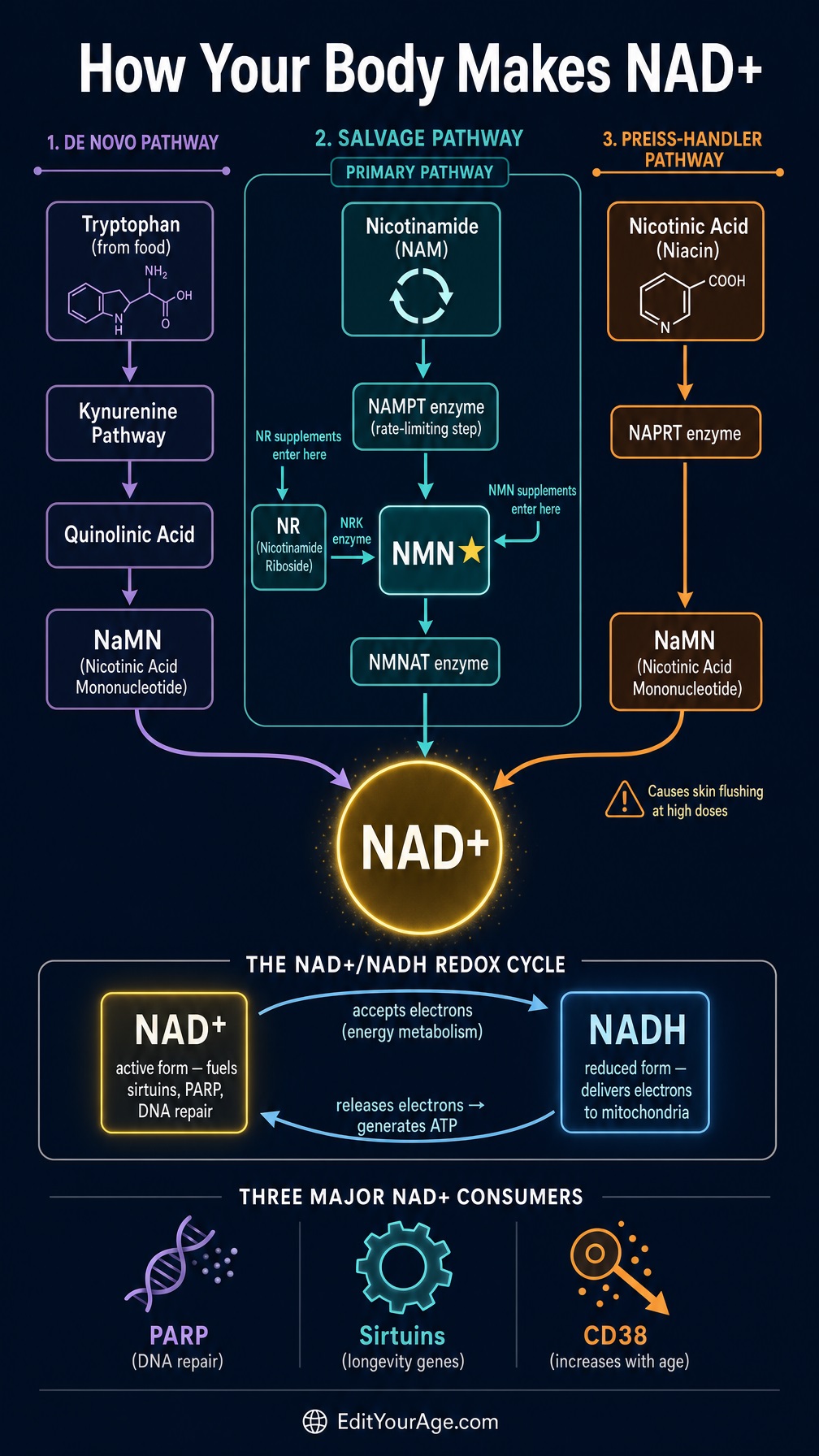
The three pathways are: the de novo pathway (built from scratch using the amino acid tryptophan), the Preiss-Handler pathway (starting from nicotinic acid, a form of vitamin B3), and the salvage pathway (recycling nicotinamide, a byproduct of NAD+ consumption, back into NAD+). Of these, the salvage pathway is by far the most active in most human tissues under normal conditions — it handles the majority of ongoing NAD+ production. The de novo pathway is largely confined to the liver and is metabolically expensive. The Preiss-Handler pathway depends on dietary nicotinic acid and is a meaningful but secondary contributor.
The De Novo Pathway: Building From Tryptophan
The de novo pathway is the only route by which the body can manufacture NAD+ entirely from scratch, without relying on preformed vitamin B3 compounds from food or recycled metabolites. It begins with tryptophan, an essential amino acid found in protein-rich foods including turkey, eggs, and dairy. Through a multi-step enzymatic process called the kynurenine pathway, tryptophan is progressively converted to quinolinic acid, which is then transformed into nicotinic acid mononucleotide (NaMN) by an enzyme called QPRT. From NaMN, a further two steps produce NAD+.
This pathway is inefficient: it requires approximately 60 milligrams of dietary tryptophan to produce just 1 milligram of niacin equivalent for NAD+ synthesis. Most tissues do not even have the full enzyme complement needed to run it; the liver does the heavy lifting. Research has shown that QPRT activity — the enzyme that commits the pathway toward NAD+ production — declines with age and with inflammation, further limiting this route as a reliable source of NAD+ over time.
The Preiss-Handler Pathway: Starting From Nicotinic Acid
Nicotinic acid (NA) — the form of vitamin B3 known as niacin — takes a distinct three-step route to NAD+. An enzyme called NAPRT converts nicotinic acid into NaMN, which then passes through the same final two steps as the de novo pathway to reach NAD+. This pathway is why high-dose niacin supplementation has long been known to raise NAD+ levels, and it is also why niacin causes the characteristic skin flushing that NMN and NR do not — the Preiss-Handler pathway produces intermediates that NMN and NR bypass entirely. For most people not taking pharmacological doses of niacin, this pathway’s contribution to total NAD+ production is modest.
The Salvage Pathway: The Dominant Route in Most Cells
The salvage pathway is where NMN and NR enter the picture directly, and it is the pathway that matters most for understanding supplement science. Every time NAD+ is consumed by a sirtuin, a PARP enzyme, or CD38, it releases nicotinamide (NAM) as a byproduct. Rather than discarding this NAM, the salvage pathway captures it and recycles it back into NAD+. This recycling is the primary mechanism by which most mammalian cells maintain their NAD+ supply day to day.
The key enzyme in this pathway is NAMPT (nicotinamide phosphoribosyltransferase), which converts nicotinamide into NMN. A second enzyme, NMNAT (nicotinamide mononucleotide adenylyltransferase), then converts NMN into NAD+. This final conversion step is rapid and efficient. NMN, therefore, sits at a particularly strategic point in the pathway: it is the immediate precursor to NAD+ and the product of the rate-limiting enzyme NAMPT. This is the biochemical basis for the argument that NMN supplementation is a direct and efficient way to raise NAD+ levels — you are supplying the intermediate that is one step from the destination.
Where NR Fits In — and How It Reaches NAD+
Nicotinamide riboside (NR) is structurally similar to NMN but lacks a phosphate group, making it a smaller molecule. In the salvage pathway, NR sits one step upstream of NMN: an enzyme called NRK (nicotinamide riboside kinase) adds a phosphate group to NR, converting it into NMN, which is then converted to NAD+ by NMNAT. So when you supplement with NR, the pathway is: NR → NMN → NAD+. When you supplement with NMN, you enter the pathway one step further along: NMN → NAD+.
This is one of the central arguments in the ongoing NMN vs. NR debate, covered in full in our dedicated article on NMN vs. NR. Being one step closer to NAD+ does not automatically make NMN superior — what matters in practice is how well each compound is absorbed from the gut, how efficiently it enters cells, and which tissues benefit most from each route.
The Cellular Entry Question: A Genuine Scientific Debate
For NMN to raise intracellular NAD+ levels, it needs to get inside cells — and this is where the science becomes genuinely contested. NMN is a phosphorylated molecule, and phosphorylated molecules generally do not cross cell membranes easily. For some time, the prevailing view was that NMN had to be converted to NR before entering cells, then converted back to NMN inside, and finally to NAD+. Under this model, NMN and NR were essentially equivalent in terms of cellular uptake.
In 2019, researchers at Washington University in St. Louis identified a specific NMN transporter protein called Slc12a8 in mouse intestinal cells, which appeared to allow NMN to enter cells directly without conversion to NR first (Grozio et al., 2019, Nature Metabolism). Subsequent research found NMN uptake was particularly rapid in cells expressing this transporter. However, the Slc12a8 finding has been disputed: other researchers, including prominent NAD+ biochemist Charles Brenner, have argued that the evidence does not conclusively show Slc12a8 functions as an NMN transporter in humans, and that multiple independent studies suggest NMN must still convert to NR before entering most human cells. The truth is that this question is not fully resolved. Both direct and indirect entry routes likely occur in different cell types and tissues, and the relative importance of each in humans is still being worked out. This uncertainty is worth knowing about when evaluating strong claims from either the NMN or NR camp.
NAD+ and NADH: The Redox Cycle That Powers Your Cells
Once NAD+ is produced inside a cell, it does not stay static. It participates in a continuous cycle that is central to how your cells generate energy — and understanding this cycle explains what NADH is and why the ratio between NAD+ and NADH matters.
In the process of breaking down glucose and fatty acids for energy — a process called cellular respiration — NAD+ acts as an electron carrier. It accepts a pair of electrons (and a hydrogen ion) from metabolic intermediates, becoming NADH in the process. NADH is simply the reduced form of NAD+: the same molecule, now carrying those extra electrons. NADH then travels to the mitochondria and delivers its electrons to the electron transport chain, the machinery that generates ATP (the cell’s primary energy currency). Once the electrons are passed on, NADH releases them and converts back to NAD+, ready to carry another load.
Why the NAD+/NADH Ratio Matters
The ratio of NAD+ to NADH in a cell is a meaningful indicator of its metabolic state. A higher ratio of NAD+ to NADH generally indicates a cell that is metabolically active and capable of efficient energy production and robust sirtuin activity. A lower ratio — more NADH relative to NAD+ — can indicate metabolic stress, reduced mitochondrial efficiency, or a buildup of the reduced form that the electron transport chain cannot process fast enough. This is one reason alcohol impairs cellular function so directly: alcohol metabolism in the liver uses large amounts of NAD+, generating a flood of NADH that shifts the ratio unfavorably and disrupts the normal balance of metabolic processes. Our article on alcohol and NAD+ covers this mechanism in detail.
NADH, NADP+, and NADPH: Keeping the Players Straight
In addition to the NAD+/NADH pair, cells also use a related molecule called NADP+ (nicotinamide adenine dinucleotide phosphate), which differs from NAD+ by a single phosphate group. NADP+ and its reduced form NADPH operate in different cellular pathways — primarily in biosynthesis reactions and antioxidant defense — rather than in energy production. When supplement labels or research papers mention NADPH, they are referring to this separate redox pair, not the NAD+/NADH system. The two pairs serve complementary but distinct roles and are kept in separate compartments within cells.
How NAD+ Is Consumed — and Why That Matters for Supplementation
NAD+ is not only produced; it is actively consumed by three major enzyme families. Sirtuins use NAD+ as a substrate to perform deacetylation reactions that regulate gene expression, stress response, and metabolism. PARP enzymes consume NAD+ during DNA repair. CD38 breaks down NAD+ to generate calcium signaling molecules. Each of these processes is biologically important, but together they create a significant ongoing demand on the NAD+ pool. Understanding consumption is as important as understanding production when thinking about why NAD+ levels fall with age.
This also clarifies why simply taking more NMN or NR may not be the complete answer for everyone. If CD38 activity is high — as it is in the context of chronic inflammation — supplementing with precursors raises the supply, but elevated consumption continues to work against it. This is one reason researchers are also interested in CD38 inhibitors, and why compounds that reduce inflammation may work synergistically with NAD+ precursors. The full picture of CD38 and NAD+ depletion is covered separately.
Putting It All Together: Why Precursor Supplementation Makes Sense
The pathway logic behind NMN and NR supplementation is straightforward once the biochemistry is clear. Your cells primarily maintain NAD+ through the salvage pathway, which depends on NAMPT to convert nicotinamide into NMN. As NAMPT activity declines with age, and as CD38 and PARP consumption increases, the salvage pathway cannot keep pace. Supplementing with NMN effectively bypasses the NAMPT bottleneck by delivering NMN directly — the intermediate that NAMPT would have produced. Supplementing with NR bypasses it one step earlier, supplying NR that NRK converts to NMN, which NMNAT then converts to NAD+.
Both approaches have shown the ability to raise NAD+ levels in human trials. The clinical evidence for each is reviewed in our articles on NMN clinical trial results and NR clinical trial results. For practical guidance on choosing between them, see our comparison article on NMN vs. NR, and for next steps on supplementation, our beginner’s NAD+ stack guide is a good starting point.
Frequently Asked Questions About the NAD+ Pathway
What Is the Difference Between NAD+ and NADH?
NAD+ and NADH are two forms of the same molecule. NAD+ is the oxidized form — the active form used by sirtuins and PARP enzymes, and the form that accepts electrons during energy metabolism. When NAD+ accepts those electrons, it becomes NADH, the reduced form. NADH then donates its electrons to the mitochondrial electron transport chain to generate ATP, releasing them and converting back to NAD+. The two forms cycle continuously, and the ratio between them reflects a cell’s metabolic state.
Does Supplementing With NMN Bypass the Body’s Natural Pathway?
Not exactly — it works with the existing pathway rather than bypassing it. NMN is a natural intermediate in the salvage pathway, sitting one step upstream of NAD+. Supplementing with NMN delivers this intermediate directly to cells, effectively bypassing the rate-limiting NAMPT enzyme step. The final conversion from NMN to NAD+ still uses the body’s own NMNAT enzymes. It is a supply-side intervention in a normal biological process, not a workaround of it.
Why Does NMN Not Cause the Flushing That Niacin Does?
Niacin (nicotinic acid) raises NAD+ through the Preiss-Handler pathway, producing intermediates that bind to receptors in skin capillaries and cause vasodilation — the familiar niacin flush. NMN enters the salvage pathway directly as NMN, bypassing these intermediate compounds entirely. NR also bypasses them. Neither NMN nor NR activates the receptors responsible for flushing, which is why both are generally better tolerated than high-dose niacin.
Can You Raise NAD+ Levels Through Diet Alone?
Diet contributes to NAD+ production, primarily through the Preiss-Handler pathway (via dietary niacin) and the salvage pathway (via nicotinamide from protein metabolism). Foods including meat, fish, mushrooms, and green vegetables provide meaningful amounts of NAD+ precursors. However, the quantities available through a normal diet are unlikely to significantly offset the age-related decline in NAD+ production, particularly in tissues like muscle and brain where the decline is most pronounced. Our article on foods that support NAD+ levels covers the dietary angle in detail.
What Does NMNAT Do, and Why Does It Matter?
NMNAT (nicotinamide mononucleotide adenylyltransferase) is the enzyme that performs the final step in converting NMN to NAD+. It exists in multiple forms that operate in different cellular compartments — the nucleus, mitochondria, and cytoplasm. Because it handles the last conversion step regardless of which pathway supplied the NMN, NMNAT is a common endpoint for all NAD+ biosynthetic routes. Its activity is generally not considered a bottleneck in the way NAMPT is, which is part of why supplementing at the NMN stage is considered more effective than trying to stimulate production further upstream.