

Most people understand intuitively that two people the same age can be in very different states of health. One 60-year-old runs marathons and has the metabolic profile of someone 15 years younger; another struggles with fatigue, stiff joints, and a growing list of prescriptions. Chronological age — the count of years since birth — does not capture this difference. Biological age attempts to. It is a measure of how your cells, tissues, and organs are actually functioning relative to a population of people your chronological age, and it has become one of the more seriously studied concepts in longevity science over the past decade. Understanding what biological age is, how it is measured, and what influences it is directly relevant to understanding why NAD+ and the supplements discussed on this site matter.
Chronological Age vs. Biological Age: The Core Distinction
Chronological age is simple: it is the number of years you have been alive, advancing at an identical rate for everyone. It is a useful rough proxy for health risk, which is why age appears in virtually every medical risk calculator. But it is a crude one. The variation in health outcomes among people of the same chronological age is enormous, and that variation is driven primarily by how differently people’s bodies have aged at the cellular and molecular level.
Biological age attempts to capture that cellular and molecular reality. A person whose biological age is lower than their chronological age has, in a measurable sense, aged more slowly — their cells show less accumulated damage, their epigenetic patterns look more like those of a younger person, their organ function markers fall in younger ranges. A person whose biological age exceeds their chronological age has aged faster than their peers, often due to a combination of genetic predisposition and lifestyle factors. The gap between these two numbers is increasingly referred to as biological age acceleration — a positive number means faster aging than expected, a negative number means slower.
This framework is relevant throughout the site because NAD+ decline, sirtuin activity, mitochondrial function, and the other cellular processes discussed across our articles are among the mechanisms that drive the divergence between biological and chronological age. Our articles on NAD+ and the hallmarks of aging and the sirtuin theory of aging connect to this framework directly.
How Biological Age Is Measured: The Main Approaches
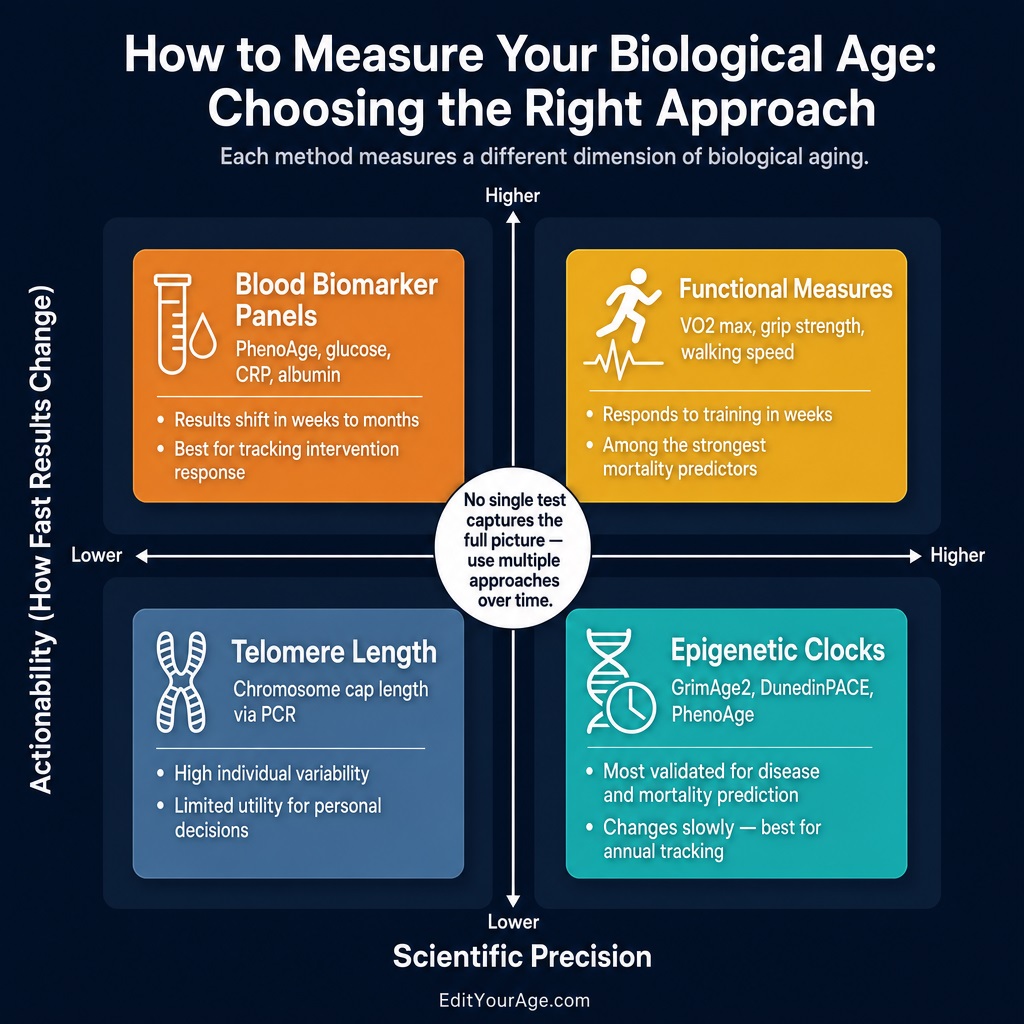
No single test captures biological age completely — aging is a multidimensional process that plays out differently across different tissues and systems. Several measurement approaches have emerged, each capturing a different aspect of biological aging, with different levels of scientific validation and practical utility.
Epigenetic Clocks: The Most Scientifically Validated Approach
Epigenetic clocks are currently the most rigorously validated biological age measurement tools available. They work by analyzing patterns of DNA methylation — chemical modifications to DNA that do not change the genetic sequence itself but regulate which genes are expressed. Methylation patterns at specific sites across the genome change in predictable ways with age, and statistical models trained on large datasets of people with known chronological ages can use these patterns to estimate biological age with considerable accuracy.
The first-generation clocks, developed by researchers including Steve Horvath starting in 2013, were primarily designed to predict chronological age from methylation data, which they did with high correlation. Second-generation clocks — including PhenoAge (developed by Morgan Levine) and GrimAge — were built to predict biological outcomes like disease risk and mortality rather than just chronological age, and they perform better as health predictors as a result. A newer metric called DunedinPACE measures not biological age at a single point in time but the pace of aging — essentially, how fast a person is currently aging relative to others. A 2025 eBioMedicine study using DunedinPACE across multiple cohorts found that smoking, higher BMI, elevated blood glucose, and poor blood pressure profiles were all associated with faster aging, while physical activity and a higher-quality diet were associated with a slower pace. GrimAge2 and DunedinPACE are considered by most researchers the most predictive tools for health outcomes currently available.
Epigenetic clock testing has become commercially available through several services. The tests typically require a blood or saliva sample. While increasingly accessible, there are important caveats: most clocks were developed primarily in European ancestry populations and their performance across diverse ethnic backgrounds is still being evaluated. Different clocks can also give meaningfully different readings from the same sample, because they measure somewhat different aspects of epigenetic aging. Treating a single clock result as a definitive biological age number is an overinterpretation of what the technology currently supports.
Telomere Length: A Real But Limited Marker
Telomeres are the protective caps at the ends of chromosomes — stretches of repetitive DNA that shorten a little each time a cell divides. When telomeres become critically short, the cell can no longer divide safely and either becomes senescent or undergoes apoptosis. Telomere length has been studied as a biological age marker for decades, and shorter average telomere length is associated with increased risk of cardiovascular disease, certain cancers, and earlier mortality across large population studies.
As a practical biological age measurement tool, telomere length has meaningful limitations. Telomere length varies considerably across different cell types within the same individual, varies between individuals of the same age to a large degree, and is influenced by genetics as much as lifestyle. A 2023 analysis found that blood-based DNA methylation measures predicted stroke and heart disease two to three times more strongly than saliva-based telomere length in the same population. This does not mean telomere length is irrelevant — it is a genuine biological aging marker — but it is not a reliable standalone test for an individual’s biological age, and commercial telomere testing kits should be interpreted with that limitation in mind.
Blood Biomarker Panels: Lower Resolution but More Actionable
A third category of biological age estimation uses standard blood chemistry markers — glucose, C-reactive protein, albumin, white blood cell count, creatinine, and others — combined in algorithms that produce a biological age estimate. Morgan Levine’s PhenoAge algorithm, which uses nine blood markers, is the most widely referenced of these. Blood biomarker-based biological age estimates are less precise than epigenetic clocks but have a practical advantage: they respond to interventions in weeks to months rather than years, making them useful for tracking whether lifestyle changes or supplements are moving health markers in the right direction. A full epigenetic clock measurement is a deeper and more expensive test; quarterly blood panels are a more accessible monitoring tool.
Functional Measures: What Your Body Can Actually Do
Beyond molecular tests, several functional measures are among the strongest predictors of longevity that exist: grip strength, walking speed, VO2 max (aerobic capacity), and balance. These do not produce a “biological age” number in the way epigenetic clocks do, but they capture something those clocks do not — the integrated output of cellular aging at the level of physical performance. Research consistently shows that VO2 max and grip strength are among the best predictors of all-cause mortality across age groups, outperforming many molecular biomarkers. Any complete picture of biological aging should include functional measures alongside molecular ones.
What Drives Biological Age Acceleration — and What Slows It
The research on what accelerates or decelerates biological aging has become considerably more precise with epigenetic clock tools. The factors that consistently appear as drivers of faster biological aging across multiple large cohort studies form a recognizable pattern — and most of them are modifiable.
Smoking is the single strongest lifestyle driver of epigenetic age acceleration identified in multiple studies, with effects measurable even at relatively low levels of exposure and showing a clear dose-response relationship. Obesity — particularly as measured by BMI and waist-to-hip ratio — is consistently associated with accelerated epigenetic aging across multiple clock measures. Elevated blood glucose is another strong signal, both as a standalone marker and as a component of metabolic syndrome. Chronic stress, operating through cortisol-driven inflammation and immune dysregulation, accelerates both telomere shortening and epigenetic aging. Poor sleep disrupts the circadian regulation of cellular repair processes. A 2025 study using data from the UK Biobank found that environmental and lifestyle factors collectively accounted for approximately 17% of mortality risk, compared to less than 2% attributable to genetics — a striking figure that underscores how much biological aging is within individual influence.
On the other side of the ledger, physical activity shows the most consistent association with slower biological aging across measurement approaches. A higher-quality diet — characterized by whole foods, adequate protein, fiber, and limited ultra-processed food — is associated with slower epigenetic aging. Maintaining healthy blood pressure and glucose regulation protects against acceleration. Not smoking and limiting alcohol are among the highest-impact modifiable factors.
Where NAD+ and Longevity Supplements Fit Into the Biological Age Picture
The cellular mechanisms that drive biological age acceleration — accumulated DNA damage, declining mitochondrial function, chronic low-grade inflammation, and reduced capacity for cellular stress response — are precisely the mechanisms that NAD+-dependent pathways are involved in regulating. Sirtuin proteins, which require NAD+ as a substrate, regulate DNA repair, inflammation control, and stress response. PARP enzymes, also NAD+-dependent, are the cell’s primary DNA damage responders. Mitochondrial function, which declines as NAD+ availability falls, is one of the strongest biological correlates of aging rate.
This does not mean that NAD+ precursor supplementation has been proven to reduce biological age in humans. It has not, at least not in large controlled trials with epigenetic clock outcomes. What exists is a mechanistic case — the pathways NAD+ supports are the pathways most associated with biological age control — and a growing base of human clinical evidence that NMN and NR supplementation raises NAD+ levels and improves some downstream markers of metabolic and physical health. Whether that translates into measurable biological age reduction in healthy adults over time is an open question that ongoing research is working to answer.
The honest framing is that supporting NAD+ levels is one reasonable component of a broader strategy aimed at slowing biological aging — alongside the lifestyle factors with stronger direct evidence. It is not a substitute for exercise, sleep quality, stress management, and dietary quality, all of which have more direct and better-established effects on biological age measures than any supplement currently does. For context on the full picture, our article on healthspan vs. lifespan addresses the broader goal these strategies serve.
Can Biological Age Be Reversed?
This is the question the longevity research community finds most interesting — and where the science is simultaneously most exciting and most in need of caution. There is genuine evidence that biological age, as measured by epigenetic clocks, can move in both directions. Interventions including caloric restriction, certain drug protocols, and intensive lifestyle changes have produced measurable reductions in epigenetic age in small human studies. David Sinclair’s research group at Harvard has published findings on epigenetic reprogramming in animal models that suggest partial restoration of younger epigenetic patterns is biologically possible.
What has not been established is whether these short-term reductions in epigenetic clock readings translate into longer healthspan or lifespan in humans. The clocks are correlates of aging, not the mechanism of aging itself, and reducing the clock reading is not the same thing as reversing the underlying biology. The distinction matters. We cover this question in depth in our article on whether biological age can actually be reversed.
Frequently Asked Questions About Biological Age
How Is Biological Age Different From “Feeling Young”?
Subjective perception of vitality is a real and meaningful health indicator, but biological age measurements go deeper than how you feel on a given day. Epigenetic clocks and blood biomarker panels measure molecular and physiological states that can diverge from subjective experience — someone can feel energetic while showing accelerated epigenetic aging, or vice versa. Biological age measurements aim to capture objective cellular-level aging processes, not subjective wellness. That said, functional measures like VO2 max and grip strength correlate with both felt vitality and longevity outcomes, suggesting the two are not entirely disconnected.
What Is the Most Accurate Biological Age Test Available?
Among currently available methods, second-generation epigenetic clocks — particularly GrimAge2 and DunedinPACE — have the strongest scientific validation for predicting health outcomes and mortality risk. DunedinPACE specifically measures the pace of aging rather than a snapshot estimate, which some researchers consider more informative. Blood-based biomarker composites like PhenoAge are more accessible and actionable for tracking responses to interventions. No single test captures all dimensions of biological aging, and using multiple measures over time provides more information than any single result.
How Much Can Lifestyle Change Your Biological Age?
The evidence suggests the effect can be substantial. A 2025 multi-cohort study found meaningful differences in epigenetic aging pace associated with smoking, BMI, blood glucose, and physical activity — each factor contributing independently. Population studies have found that individuals with the most favorable lifestyle profiles show epigenetic ages several years younger than same-age peers with less healthy profiles. Whether targeted interventions can produce the same magnitude of benefit as lifelong healthy habits is less clear, but research on intensive lifestyle protocols has shown short-term reductions in epigenetic age measurements.
Is Biological Age Mostly Determined by Genetics?
Research suggests environmental and lifestyle factors play a considerably larger role than genetics in driving biological age differences and mortality risk. A 2025 study found environmental exposures accounted for approximately 17% of mortality risk compared to less than 2% attributable to genetics. This does not mean genetics are irrelevant — some people are predisposed to age more slowly or quickly — but it does mean that the trajectory of biological aging is substantially within individual influence through lifestyle choices.
Can Supplements Actually Change Your Biological Age?
There is no supplement with proven, large-scale human evidence of reducing biological age as measured by validated epigenetic clocks in healthy adults. Some small studies have reported short-term epigenetic age reductions with specific interventions, but these have not been replicated at scale. Supplements that support the cellular mechanisms most associated with biological age — NAD+ precursors, compounds that reduce inflammation, agents that support mitochondrial function — have a mechanistic rationale for potentially influencing biological aging, but this remains an area where the evidence is developing rather than established. Lifestyle factors have more direct evidence of biological age effects than any currently available supplement.