
Once you understand that NAD+ declines with age and that this decline has real consequences for cellular health, the obvious next thought is: why not just take NAD+ directly? Plenty of products on the market are sold as “NAD+ supplements,” some at premium prices, and their labels make confident claims about raising cellular NAD+ levels. The problem is that the chemistry does not cooperate. NAD+ is a molecule that the body produces and uses inside cells, and the path from a capsule in your stomach to inside a cell turns out to be an obstacle course that NAD+ is poorly equipped to navigate. This article explains why — and what the more evidence-backed alternatives actually are.
The Core Problem: NAD+ Is the Wrong Size and the Wrong Shape for Oral Delivery
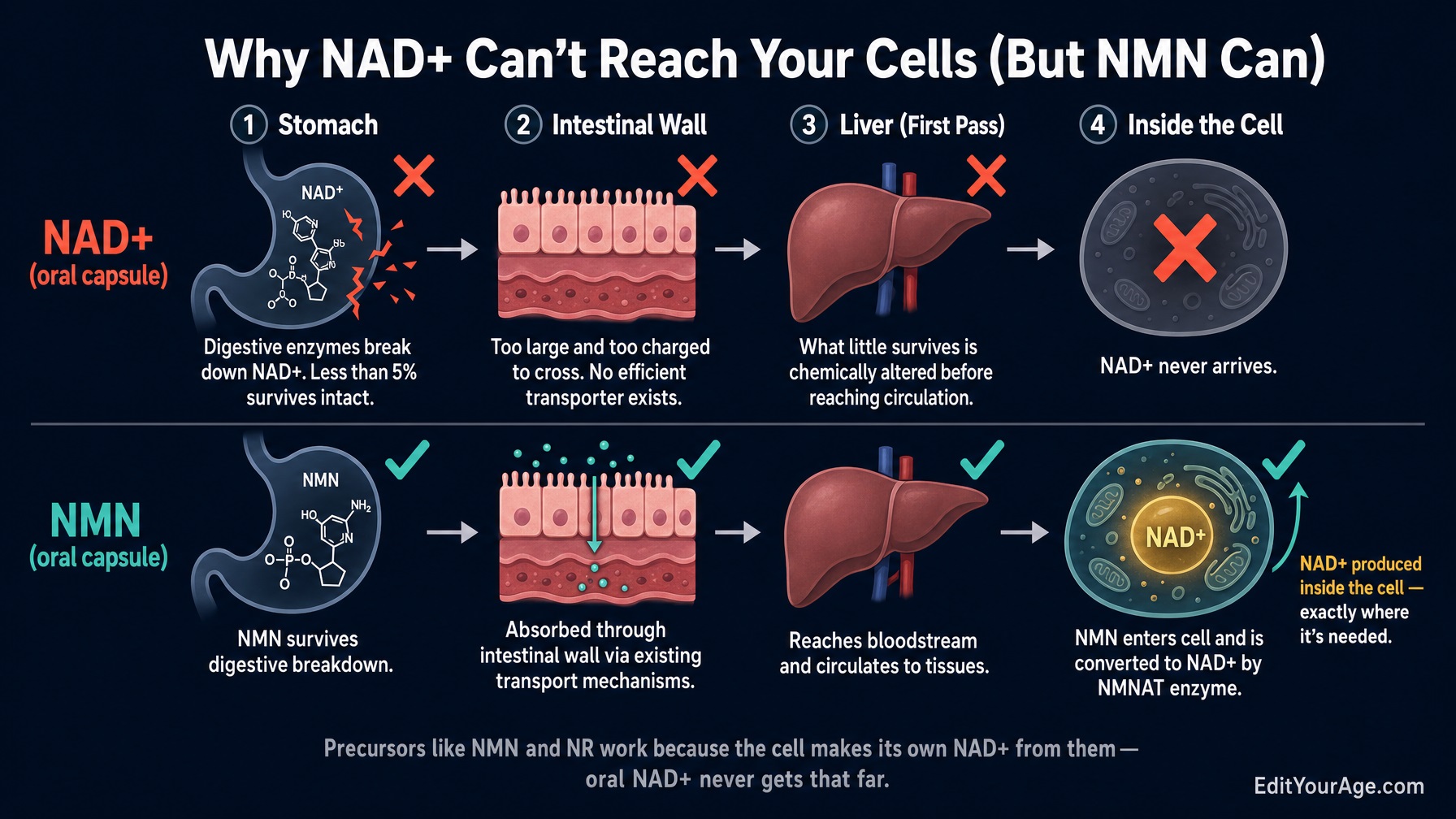
For any molecule taken orally to raise levels in tissues and cells, it needs to accomplish several things in sequence: survive the digestive environment, cross the intestinal wall into the bloodstream, avoid being extensively broken down by the liver before reaching circulation, and then enter individual cells. NAD+ runs into significant obstacles at nearly every stage of this process.
NAD+ has a molecular weight of approximately 663 daltons, which places it at the larger end of what the gut can absorb efficiently. More importantly, it carries a strong negative electrical charge. Cell membranes are built from lipids — fats — and are relatively impermeable to large, charged molecules. The general rule in pharmacology is that molecules need to be small and either electrically neutral or weakly charged to cross lipid membranes by passive diffusion. NAD+ fails on both counts. There are no well-characterized transport proteins in the intestinal wall that carry intact NAD+ efficiently into the bloodstream, which means even what survives the stomach has limited means of crossing into circulation.
What Digestive Enzymes Do to NAD+
The gastrointestinal tract is an environment designed to break down complex molecules into their components. Digestive enzymes and the acidic conditions of the stomach begin disassembling NAD+ before it reaches the small intestine, where most absorption occurs. By the time any residual NAD+ reaches the absorptive surface of the intestinal wall, a substantial portion has already been fragmented into smaller components — primarily nicotinamide, which is one of the raw materials the body can use to rebuild NAD+ through the salvage pathway, but which is not NAD+. Research suggests that oral bioavailability of intact NAD+ is below five percent under controlled conditions — with some estimates placing it considerably lower.
First-Pass Metabolism: The Liver’s Role
Even if a small amount of intact NAD+ were absorbed through the intestinal wall, it would face a further obstacle called first-pass metabolism. Blood from the intestines flows directly to the liver before entering general circulation — a biological filter that processes absorbed compounds before they reach other tissues. The liver is highly active in NAD+ metabolism and would chemically modify much of what arrived intact from the gut. What ultimately reaches the bloodstream in meaningful concentrations would be metabolites of NAD+, not NAD+ itself. The National Advertising Division of the Better Business Bureau confirmed this picture in a self-regulatory proceeding, noting that there did not appear to be any human clinical studies on the oral ingestion of NAD+ demonstrating effectiveness — a notable finding given how widely these products are marketed.
What About Liposomal NAD+ Products?
Liposomal delivery has become a popular marketing concept in the supplement industry, and NAD+ products using this approach have been heavily promoted as a solution to the absorption problem. The pitch is straightforward: wrap the NAD+ molecule in a tiny fat-based particle (a liposome) that protects it from digestive breakdown and fuses with cell membranes to deliver its payload directly. The concept has genuine scientific merit in pharmaceutical contexts — liposomal drug delivery is a real and established technology used in intravenous medications. The question is whether it translates meaningfully to oral NAD+ supplements.
Here the science parts company with the marketing. Liposomes are structurally delicate. The heat, compression, and drying involved in manufacturing standard tablet and capsule supplements tends to disrupt the liposomal structures before the product even reaches the consumer. Powdered or dried liposomal NAD+ products are particularly vulnerable to this degradation during processing. A 2025 laboratory study found that a liposomal NAD+ formulation improved NAD+ uptake in cell cultures and improved skin penetration by approximately 30% compared to plain NAD+ — promising early findings, but conducted in cell cultures and tissue models rather than in people taking oral supplements. No well-designed human clinical trial has yet demonstrated that oral liposomal NAD+ meaningfully raises intracellular NAD+ levels. The technology may develop further, but as of now it does not have the evidence base that NMN and NR do.
NAD+ by Injection and IV: Does Bypassing the Gut Help?
If the problem is digestive destruction and poor intestinal absorption, an obvious question is whether delivering NAD+ by a route that bypasses the gut entirely — intravenous infusion or subcutaneous injection — changes the picture. The answer is: somewhat, but the research remains very limited and the practical picture is complicated.
Intravenous NAD+ infusions do raise blood NAD+ levels — that part is straightforward, since the molecule is delivered directly into the bloodstream. Clinics offering IV NAD+ therapy have proliferated, and some users report subjective improvements in energy and mental clarity. A 2024 pilot study compared IV NR (a precursor) to IV NAD+ in healthy adults and found both raised blood NAD+ acutely. However, the research on what IV NAD+ actually accomplishes inside tissues, how long any effect persists, what the optimal protocols are, and whether the subjective benefits translate into measurable biological outcomes is thin. The cost of IV NAD+ — typically $200 to $1,000 per session — and the inconvenience of clinical administration make it impractical as a regular strategy for most people. Subcutaneous injection is a lower-cost alternative that some longevity clinics and direct-to-consumer services now offer, and it does avoid first-pass metabolism, but the same evidence limitations apply.
The honest position on injectable and IV NAD+ is that the science has not yet validated it as clearly superior to well-dosed oral precursor supplementation with NMN or NR. The early site of the article on NAD+ at what NAD+ is and our article on how NAD+ levels change with age explain why supporting NAD+ matters — but the delivery mechanism matters just as much as the intent.
Why Precursors Work When NAD+ Itself Doesn’t
The reason NMN and NR succeed where NAD+ fails comes down to molecular size and the cell’s own biosynthetic machinery. Both NMN and NR are substantially smaller than NAD+ and are structured in ways that allow them to be absorbed from the gut, survive first-pass metabolism to a meaningful degree, and enter cells through existing transport mechanisms. Once inside, the cell’s own enzymes convert them to NAD+ through the final steps of the salvage pathway.
This is not a workaround of normal biology — it is how the salvage pathway is designed to work. The body has been recycling nicotinamide into NAD+ through NMN for billions of years of evolution. Supplementing with NMN or NR simply feeds more substrate into a pathway that already exists and already functions. The cell does the final conversion itself, which means the NAD+ is produced where it is needed — inside the cell — rather than needing to travel there from outside.
Multiple human clinical trials have confirmed that both NMN and NR raise NAD+ levels measurably in blood, and some have confirmed increases in muscle tissue as well. The same cannot be said for oral NAD+ products. For a full comparison of how NMN and NR stack up against each other and against oral NAD+, see our plain-English comparison of NAD+, NMN, NR, and NADH.
How to Identify NAD+ Products That Are Worth Your Money
Given the volume of NAD+ products on the market and the wide variation in what they actually contain and how they work, a few practical guidelines help separate well-evidenced products from those riding the category’s marketing momentum.
Products labeled as “NAD+” that contain NAD+ itself as the active ingredient — not NMN, NR, or another precursor — lack meaningful human clinical evidence and should be approached with skepticism, regardless of price or packaging. Products labeled “liposomal NAD+” face the same evidence gap, plus the additional manufacturing stability concerns described above. Products containing NMN or NR as the active ingredient have genuine human clinical evidence behind them and are the appropriate starting point for anyone whose goal is to raise cellular NAD+ levels.
Within the NMN and NR categories, quality varies significantly across brands. Third-party testing for purity and label accuracy, transparent manufacturing information, and reasonable dosing aligned with what clinical trials have used are all meaningful indicators of product quality. Our detailed guides on how to choose an NMN supplement and how to choose an NR supplement cover the specific criteria in depth.
What This Means in Practice
The supplement market’s habit of selling products labeled “NAD+” alongside products containing actual NAD+ precursors creates genuine confusion for consumers. The label says NAD+; the underlying science says the molecule on the label is not what will raise your cellular NAD+ levels. What will — with meaningful supporting evidence — is NMN or NR, neither of which is labeled “NAD+” but both of which reliably produce NAD+ inside cells through the body’s own metabolic machinery.
This is one of the clearest cases in the supplement space where understanding the underlying biochemistry protects you from spending money on products that cannot deliver what they imply. If your goal is to support NAD+ levels as part of a longevity-oriented supplement approach, the path runs through NMN or NR — not through the molecule itself. Our beginner’s NAD+ stack guide is a practical starting point for building a supplement approach grounded in the actual evidence.
Frequently Asked Questions About Oral NAD+ Supplementation
If Oral NAD+ Doesn’t Work, Why Is It So Widely Sold?
The supplement industry is not required to demonstrate that products work before selling them — only that they are safe. Products labeled as NAD+ supplements can be legally marketed as long as they make no explicit drug claims and meet basic safety standards. The consumer demand for anything associated with longevity research, combined with limited public understanding of the absorption science, has created a large market for NAD+ products that the evidence does not support. This is unfortunately common in the supplement space and is one of the reasons understanding the underlying biology matters when making purchase decisions.
Is There Any Scenario Where Oral NAD+ Might Work?
Possibly in the gut itself. The intestinal lining has access to what is absorbed before it reaches circulation, and some researchers have speculated that oral NAD+ may support NAD+ levels in gut tissue specifically, even if it does not reach other organs meaningfully. This has not been well studied. The 2025 liposomal NAD+ cell culture research also suggests there may be topical or localized applications where direct NAD+ delivery is more feasible — particularly in skin, where absorption does not depend on the gut. Neither of these scenarios validates the broad claims made for standard oral NAD+ capsules.
Do Sublingual NAD+ Products Work Better Than Capsules?
Potentially, though the evidence is very limited. Sublingual delivery — dissolving a tablet under the tongue — allows some absorption directly through the oral mucosa, bypassing gastric digestion and first-pass liver metabolism. This approach works well for certain small molecules. Whether NAD+, at 663 daltons, is small enough and structurally suited enough to absorb meaningfully via the sublingual route has not been rigorously tested in human trials. It is a more plausible delivery method than standard oral capsules, but plausible is not the same as proven.
What Is the Difference Between NAD+ IV Therapy and NMN Supplementation?
IV NAD+ delivers the molecule directly into the bloodstream, bypassing digestion entirely. This does raise blood NAD+ levels. NMN supplementation delivers a precursor that cells absorb and convert to NAD+ internally. Both approaches aim to raise cellular NAD+ through different routes. IV therapy is significantly more expensive, requires clinical administration, and lacks the same depth of controlled human research that NMN and NR supplementation have accumulated. For most people pursuing NAD+ support as part of a general longevity approach, oral NMN or NR represents a more practical and better-evidenced starting point than IV therapy.
Could Future Formulations Make Oral NAD+ Viable?
Possibly. Delivery technology continues to advance, and improved liposomal formulations, novel encapsulation methods, or other approaches may eventually produce oral NAD+ products that meaningfully raise cellular levels. The 2025 cell culture research on liposomal NAD+ shows genuine scientific interest in this direction. As of now, however, no oral NAD+ product has demonstrated this in human clinical trials. The precursor approach — NMN and NR — has a proven track record that future NAD+ delivery innovations would need to match or exceed to displace.